By Mark Anderson, Founder and CEO, Captain Drake, LLC · 8-minute read
Short answer: Citric acid isn’t genetically modified, but it’s often made from genetically modified crops. Most citric acid is made by fermenting sugar with a mold, Aspergillus niger, and in the United States that sugar comes mainly from corn. Non-GMO citric acid starts with a non-GMO sugar, such as tapioca or cane, and a mold strain that isn’t genetically engineered.
I grew up on a farm and ranch in North Dakota, where we grew potatoes under contract for Frito-Lay along with wheat, corn and soybeans. I was farming in 1996, when genetically engineered corn and soybeans were introduced commercially in the United States, so I watched that change happen in the field.
Since I founded Captain Drake in 2012, we’ve sourced non-GMO citric acid for US food and beverage manufacturers. If you buy citric acid for a Non-GMO Project Verified or organic product, “is it GMO?” is the right question to ask. The answer depends on two things the label never shows: the sugar the citric acid was made from, and the mold that made it.
In this article
How is citric acid made?
Almost all citric acid is made by fermentation, not squeezed from lemons. The US Environmental Protection Agency describes production as “almost exclusively” microbial. Producers ferment a sugar source, such as cornstarch, tapioca starch, cane sugar or molasses, with the mold Aspergillus niger, which releases citric acid into the liquid. The mold is then filtered out, and the acid is recovered, purified and crystallized as anhydrous citric acid or citric acid monohydrate.
US food regulations recognize citric acid recovered from Aspergillus niger fermentation liquor, alongside recovery from lemon or pineapple juice and fermentation by Candida yeasts (21 CFR 184.1033). Sodium citrate, potassium citrate and calcium citrate are made from citric acid, so they carry the same inputs.
Is citric acid GMO?
The molecule isn’t. Citric acid made from corn, tapioca or cane sugar is the same compound, C6H8O7. What can be genetically engineered is what goes into making it, and that is what non-GMO standards check. Two inputs decide it.
The sugar
Fermentation needs a sugar source, and in the United States the principal one is cornstarch, according to the US International Trade Commission. That’s where genetic engineering comes in: in 2025, 92% of US corn acres were planted with herbicide-tolerant genetically engineered seed, according to the USDA Economic Research Service. The Non-GMO Project treats corn as a high-risk crop and names citric acid among the harder-to-spot ingredients made from it.
The mold
The “black mold” in searches such as “citric acid from GMO black mold” is Aspergillus niger. Industrial strains are selected for high citric acid yields, and genetically engineered strains exist. Organic rules separate the two: the Organic Materials Review Institute (OMRI) allows citric acid made with a strain that isn’t genetically engineered, even when the sugar came from GMO crops, but not citric acid made by a genetically engineered strain. The Non-GMO Project also counts microorganisms among the inputs it treats as high-risk.
So “non-GMO citric acid” should mean both things: a non-GMO sugar source and a non-GMO strain, documented for each lot.
How is non-GMO citric acid made?
Non-GMO citric acid is made the same way as any citric acid. What changes is that every input is chosen, and documented, to keep genetically engineered material out.
- 1Start with a non-GMO sugar. The non-GMO citric acid we source starts with tapioca starch in Thailand or cane sugar in South America, instead of corn. Every lot’s documents should name the crop, because the non-GMO claim starts there.
- 2Convert the starch with documented enzymes. Tapioca starch is broken down into glucose with enzymes before fermentation. The Non-GMO Project names enzymes among its high-risk inputs, so they need non-GMO documentation too. Cane sugar and molasses skip this step.
- 3Ferment with a strain that isn’t genetically engineered. The mold Aspergillus niger turns the sugar into citric acid. The strain must not be genetically engineered, and crop-based nutrients in the growth medium need non-GMO sourcing as well, because the Non-GMO Project also counts high-risk crops used in growth media.
- 4Recover the acid. The mold is filtered out, and the citric acid is separated from the broth, either by precipitating it with lime (calcium hydroxide) and freeing it again with sulfuric acid, or by solvent extraction.
- 5Purify, crystallize and size it. The acid is purified and crystallized as anhydrous citric acid or citric acid monohydrate, then screened or milled to size, from granular to 200 mesh.
- 6Document every lot. A certificate of analysis shows the lot meets its specification, and the feedstock and strain records support the non-GMO claim. Our citric acid is Non-GMO Project Verified.
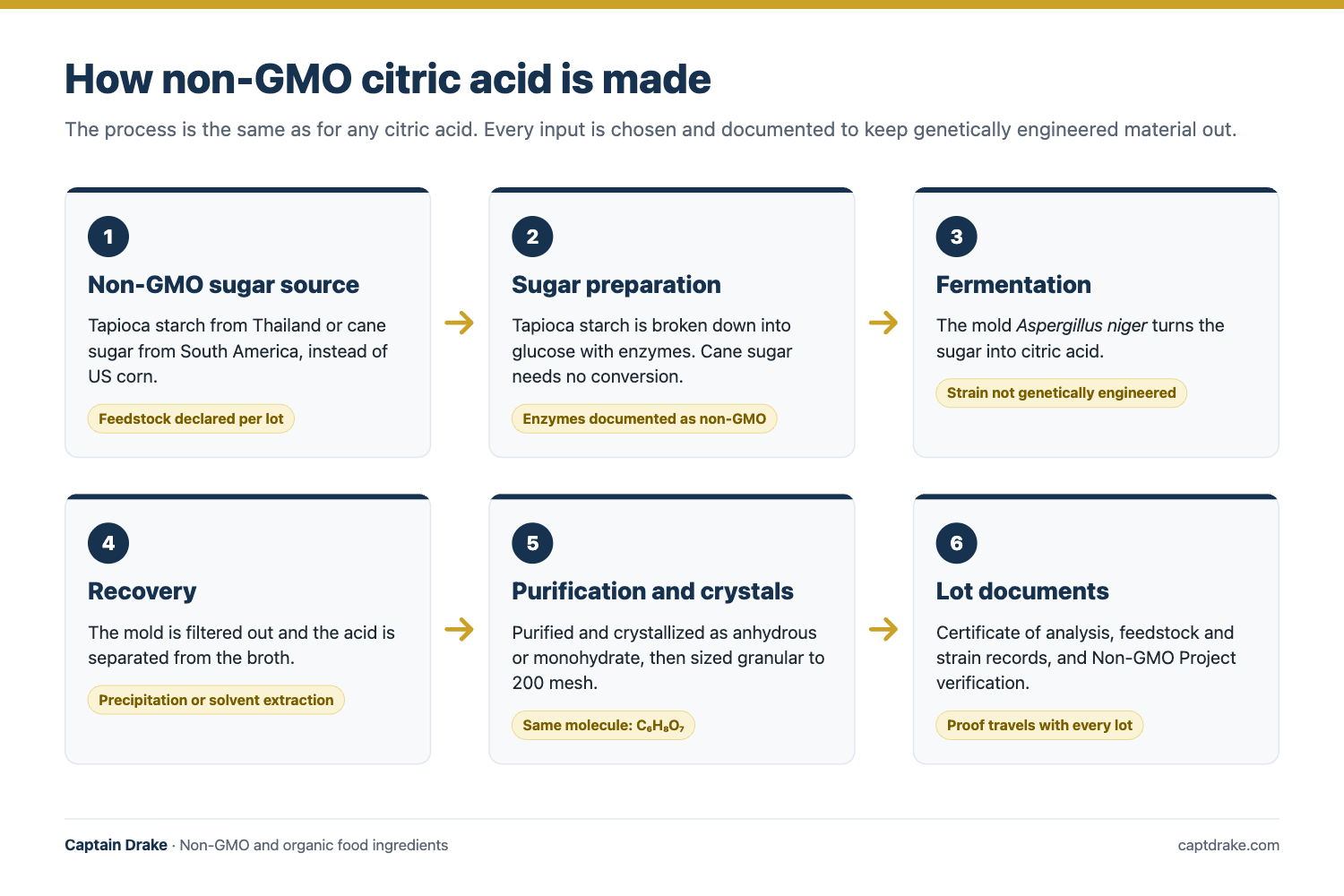
None of these steps changes the molecule. They change what you can prove about it. In the United States, step 1 is the hard part.
Why is US-made citric acid rarely non-GMO?
Because US production runs mainly on corn, and most US corn is genetically engineered.
The US International Trade Commission names three US producers of citric acid and citrate salts, and reports that they were the only known US producers in 2024. Cornstarch is their principal substrate, though they may also use molasses. From what I know of the market, all three use GMO corn to produce their citrates: citric acid, sodium citrate and potassium citrate.
Most citric acid used in the United States is imported anyway. The EPA’s supply-chain profile says domestic production has fallen over the past 20 years. In 2015 the US made about 32 million kg and imported about 75 million kg, and Thailand was the main import source from 2015 to 2020. So if your formula needs non-GMO citric acid, the practical route is usually an imported product made from a non-GMO feedstock.
Where does non-GMO citric acid come from?
From producers that ferment a non-GMO sugar source. We source non-GMO citrates from Thailand, where producers use non-GMO tapioca starch instead of GMO corn, and from South America, where the feedstock is non-GMO cane sugar.
| Feedstock | Where it’s used | Can the citric acid be non-GMO? |
|---|---|---|
| Cornstarch | United States, China | Only with identity-preserved non-GMO corn; 92% of US corn acres were genetically engineered in 2025 |
| Tapioca (cassava) starch | Thailand | Yes, with feedstock documents for each lot |
| Cane sugar or molasses | South America | Yes, when the cane is documented as non-GMO |
| Beet sugar | United States | Rarely: 98% of US sugar beet acres were herbicide-tolerant by 2013 |
Imported doesn’t mean non-GMO. The Trade Commission’s review of Chinese imports found cornstarch is the principal substrate in China, too. Origin alone proves nothing; the feedstock and strain documents do. Our non-GMO citric acid anhydrous page lists the grades, particle sizes and packaging we supply.
Non-GMO Project Verified or USDA Organic: what each requires
The two claims treat citric acid differently, so one doesn’t imply the other.
| Point | Non-GMO Project Verified | USDA Organic |
|---|---|---|
| How citric acid is treated | A high-risk input: both the crop in the growth medium and the microorganism count | Allowed as a nonsynthetic ingredient “produced by microbial fermentation of carbohydrate substances” (7 CFR 205.605(a)) |
| Sugar from GMO crops | Makes the input high-risk, so non-GMO sourcing must be documented | Not ruled out: OMRI allows citric acid from a non-GE strain even on GMO sugar |
| Genetically engineered mold strain | High-risk | Prohibited, according to OMRI |
| Who decides | Your verifier | Your certifier |
An organic claim doesn’t guarantee a non-GMO feedstock, and a Non-GMO Project claim needs documents for both the sugar and the strain. See what Non-GMO Project verification covers for the documents behind our ingredients.
How to specify non-GMO citric acid
Start with the feedstock and work forward. A specification for a non-GMO product should cover:
- Grade: FCC for food and beverage, or USP where the end use calls for it.
- Form: anhydrous or monohydrate.
- Particle size: granular, fine granular or 200 mesh. We have 200 mesh milled in the United States by a contract miller, because fine powder can harden in an ocean container.
- Feedstock and origin: the crop (tapioca or cane) and the country of origin, for every lot.
- Strain: a statement that the Aspergillus niger strain isn’t genetically engineered.
- Non-GMO documentation: Non-GMO Project verification for the ingredient, or the documents your verifier asks for.
- Certificate of analysis: one per lot, matched to the lot number on the bag.
- Kosher, halal and allergen statements, with the shelf life and storage conditions.
- Packaging: 50 lb bags, 25 kg bags or 2,250 lb tote sacks, shipped as LTL pallets up to full truckloads.
Captain Drake supplies specification sheets, certificates of analysis and Non-GMO Project documents with each shipment.
Buying citric acid for a non-GMO product?
Request a quote and tell us the grade, form, particle size and quantity you need.
Frequently asked questions
Is citric acid made from black mold?
Most of it is. Producers ferment sugar with Aspergillus niger, a mold sometimes called black mold, then filter the mold out and purify the acid. US regulations recognize citric acid recovered this way (21 CFR 184.1033).
Is non-GMO citric acid different from regular citric acid?
Not chemically. The molecule is the same. The difference is the sugar and the mold used to make it, and the documents that prove both.
Can citric acid be organic?
In US organic processing, citric acid is allowed as a nonorganic ingredient when it’s produced by microbial fermentation of carbohydrates (7 CFR 205.605(a)). OMRI’s review then looks at the strain: citric acid from a genetically engineered strain isn’t allowed. Your certifier decides which sources qualify.
Why is most citric acid in the US imported?
Domestic production has fallen for two decades. In 2015 the US imported about 75 million kg of citric acid and made about 32 million kg, according to the EPA, and Thailand was the main source of imports from 2015 to 2020.
Sources
- Citric Acid and Certain Citrate Salts from China (Third Review), Publication 5740, US International Trade Commission, May 2026
- Recent Trends in GE Adoption, USDA Economic Research Service, 2025 plantings
- Herbicide-tolerant sugarbeets accounted for 98 percent of sugarbeet acreage by 2013, USDA Economic Research Service
- The GMO High-Risk List: Corn, Non-GMO Project, July 3, 2025
- High-Risk Inputs: Examples, Non-GMO Project, December 2020
- Citric Acid Supply Chain – Full Profile, US EPA, December 2022
- 21 CFR 184.1033, Citric acid
- 7 CFR 205.605, Nonagricultural substances allowed in organic products, Legal Information Institute
- GMOs and processing inputs, Organic Materials Review Institute
About the author
Mark Anderson founded Captain Drake, LLC in 2012 and is its chief executive officer. He grew up farming and ranching in North Dakota and traded grain and dairy commodities before building non-GMO ingredient supply chains for US food and beverage manufacturers. Read Mark Anderson’s full profile →
Related reading